C3PAO Assessment RFQ Template (Free): CMMC Level 2
A free C3PAO RFQ for a CMMC Level 2 certification assessment: paste-ready requirements for scope, team, independence and pricing, provider questions and…
Word · FreeDownload Template →
Paste-ready CNAPP requirements (CSPM, CIEM, CWPP, KSPM, image, IaC and secrets scanning, attack paths, CDR), vendor questions that separate platforms, and a weighted scoring rubric.
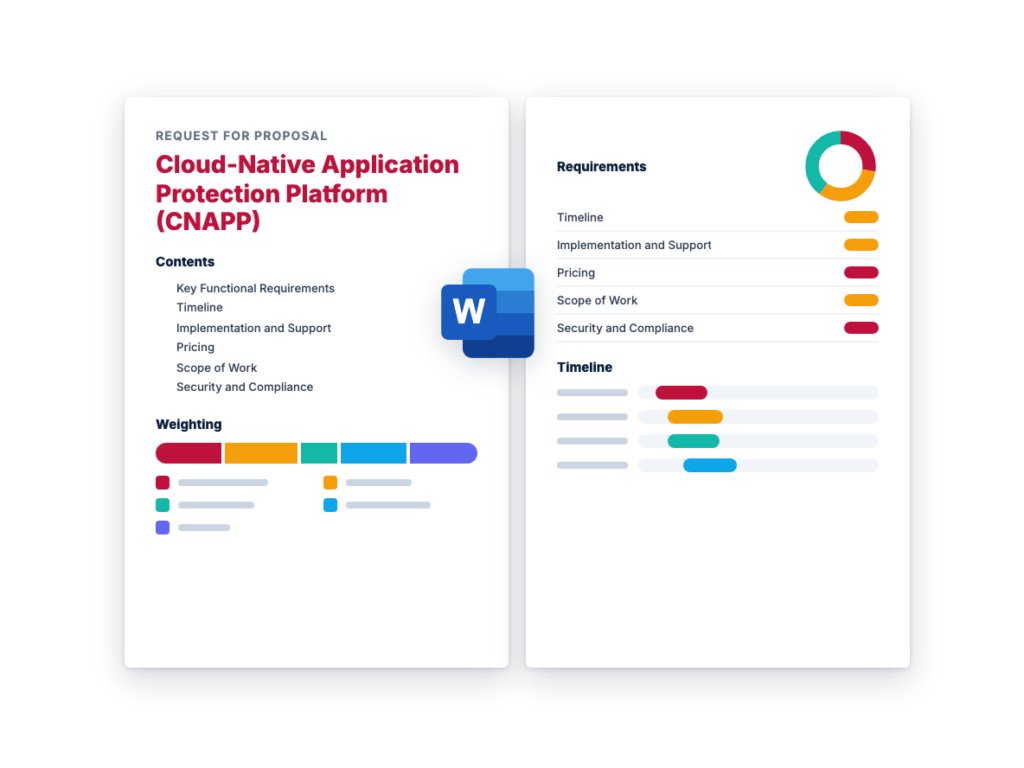
See the structure before you download. The Word file has every section listed below, ready to fill in.
The sections in the document, in order.
Use this CNAPP RFP template when you're buying a cloud-native application protection platform to secure your cloud accounts, Kubernetes clusters, containers, virtual machines and serverless functions from code to runtime, or replacing separate CSPM, CWPP and CIEM tools with one platform.
Because a CNAPP combines these functions in one platform, the template lists each function separately and marks every requirement Must-have or Nice-to-have, so a vendor that is strong in only part of the platform can show that honestly.
It's written for the cloud security, platform engineering and procurement team running the evaluation, and it covers when to issue an RFI first, the requirements to send, the questions that separate vendors, and how to score the answers.
Download the editable Microsoft Word version below. Every requirement, vendor question and scoring weight on this page is in the document, ready to tailor and send.
A CNAPP evaluation involves cloud security, platform engineering, development and security operations teams, and the platform needs read access across your whole cloud estate, so much of the early work is agreeing on scope, permissions and who will act on findings. The example schedule in this template runs about 12 weeks from kickoff to contract award; allow more if your security team reviews each vendor's cloud permissions before anything is connected, or if the proof of value covers several cloud providers.
Each line is written to paste straight into your RFP. Must-have means a vendor that cannot meet it is out; Nice-to-have earns extra points. Change the priorities to fit your situation, and delete what doesn't apply.
| ID | Requirement | Priority |
|---|---|---|
| F1 | Agentless discovery and a continuously updated inventory of cloud resources across [list cloud providers] through read-only cloud APIs, covering compute, containers and Kubernetes services, serverless functions, storage, databases, networking and identities, with onboarding at the cloud organization level so new accounts, subscriptions and projects are added automatically. State how soon a new resource appears and how often posture is reassessed. | Must-have |
| F2 | Continuous detection of cloud misconfigurations (CSPM), with built-in checks mapped to the CIS Benchmarks published for our cloud providers and to [list frameworks, for example NIST SP 800-53, ISO/IEC 27001 and PCI DSS], custom policies we write, and compliance reports by framework, account and team that we can export as audit evidence. State how custom policies are written. | Must-have |
| F3 | Effective permissions analysis (CIEM) for human and non-human identities, including users, groups, roles, service accounts and workload identities, resolved across identity policies, resource policies, group membership, inherited permissions and cross-account or cross-project trust, so we can see what each identity can actually do. | Must-have |
| F4 | Identification of unused and excessive permissions from activity logs over a lookback period we set, with least-privilege policy recommendations we review before applying, plus findings for inactive identities, long-lived access keys, console users without MFA, privilege-escalation paths and external accounts with access. | Must-have |
| F5 | Agentless scanning of virtual machines and container hosts using disk snapshots, covering operating system packages, language libraries, malware, secrets and insecure configuration, with nothing installed on the workload. State how often workloads are rescanned and how soon a new workload is scanned. | Must-have |
| F6 | Agent-based runtime protection for Linux hosts, Kubernetes nodes and containers that detects threats as they happen, such as reverse shells, crypto-mining, privilege escalation, container escape attempts and execution of binaries that were not in the original image (drift). State Windows support. | Must-have |
| F7 | Response actions from the runtime sensor, such as ending a process, stopping or pausing a container, or isolating a workload from the network, taken by an analyst or automatically only for the rules we enable. | Nice-to-have |
| F8 | Scanning of serverless functions for vulnerable dependencies, embedded secrets and overly broad execution roles. State whether runtime protection for serverless functions is offered, for which runtimes, and how it is deployed. | Must-have |
| F9 | Kubernetes security posture management (KSPM) for managed and self-managed clusters: cluster and node configuration checked against the CIS Benchmarks for Kubernetes and, where published, for our managed Kubernetes services, risky workload settings such as privileged containers, host access and missing resource limits, role-based access control (RBAC) analysis and missing network policies. List supported distributions and managed services. | Must-have |
| F10 | Container image scanning in registries, in CI/CD pipelines and for running images, covering operating system packages, language libraries, malware, secrets and risky build settings such as running as root. List the supported registries and package ecosystems. | Must-have |
| F11 | Scanning of infrastructure-as-code in pull requests and pipelines for [list formats, for example Terraform, Kubernetes manifests, Helm charts and each cloud provider's template format], with results shown to developers in the pull request. State which policies are shared with runtime posture checks, so the same rule applies before and after deployment. | Must-have |
| F12 | Detection of exposed secrets, such as cloud access keys, tokens, passwords and private keys, in code repositories, infrastructure-as-code, container images, virtual machine disks and serverless function code, with secret values masked. State whether the platform can check if a secret it finds is still valid. | Must-have |
| F13 | A security graph linking resources, identities, network exposure, vulnerabilities, secrets and data, with attack path analysis that shows how an attacker could move from an exposed entry point to sensitive data or high-privilege roles, and a query interface for our own searches and custom policies. | Must-have |
| F14 | Prioritization of findings by internet exposure worked out from actual network paths (firewall rules, network access lists, load balancers and gateways), exploitability (such as listing in the CISA Known Exploited Vulnerabilities catalog and EPSS scores), effective permissions, data sensitivity where known, and the business criticality we assign, with the evidence behind each ranking visible to the analyst. | Must-have |
| F15 | Use of runtime data to show which vulnerable packages are actually loaded or in use in running workloads, so findings in unused packages can be ranked lower. | Nice-to-have |
| F16 | Cloud detection and response (CDR): near-real-time detection of threats from cloud audit logs, Kubernetes audit logs and workload runtime events, such as unusual credential use, privilege changes, disabling of logging and unusual data access, correlated into incidents with an investigation timeline and mapped to MITRE ATT&CK, including its Cloud and Containers matrices. State the typical delay from event to alert. | Must-have |
| F17 | Remediation guidance for every finding, with console steps, command-line commands or infrastructure-as-code fixes; assignment to the owning team, identified from cloud tags, account structure or repository mapping; risk acceptance with a named approver and an expiry date; and automatic closure when a rescan confirms the fix. | Must-have |
| F18 | Code-to-cloud tracing that links a running workload or cloud resource to the container image, infrastructure-as-code file, repository, commit and pipeline that produced it, so fixes can be made at the source. State whether fixes can be proposed to developers as pull requests. | Nice-to-have |
| F19 | Guardrails that can be set per policy to alert only or to block: CI/CD gates that fail a build on findings above a severity we set, and Kubernetes admission control that rejects workloads that break policy, with time-limited exceptions that need approval. | Must-have |
| F20 | Data security posture management (DSPM): discovery and classification of sensitive data in cloud storage and databases, used to raise the priority of findings that expose it. State whether classification reads data contents, where it runs and whether it is licensed separately. | Nice-to-have |
| F21 | AI workload coverage, sometimes called AI security posture management (AI-SPM): an inventory of the managed AI services, models, model endpoints and related resources in our cloud accounts, with posture checks such as public exposure of model endpoints, broad access to training data and excessive permissions for AI services and agents. State which AI services are supported today. | Nice-to-have |
| ID | Requirement | Priority |
|---|---|---|
| T1 | One platform with one inventory, one risk model and one console across all proposed functions. Identify any function that runs as a separate product, uses a separate console or data store, or is licensed as a separate module. | Must-have |
| T2 | Read-only access by default, through roles we create from vendor-provided templates and cross-account trust or short-lived credentials rather than long-lived access keys. List every permission requested, and identify any that allow reading disk snapshots or data contents. | Must-have |
| T3 | A documented agentless scanning architecture: whether snapshots are scanned in our cloud accounts or in the vendor's environment, what leaves our accounts, how long anything is kept, and an estimate for our environment of the compute, storage and data-transfer costs that scanning will add to our cloud bills, with controls to schedule or limit it. | Must-have |
| T4 | Published details for the runtime sensor: supported operating systems, kernel versions and Kubernetes distributions, deployment method, how it collects events (for example eBPF or a kernel module), CPU and memory overhead, and its behavior if it fails or loses contact with the service, which must never stop the workload. State support for self-managed clusters and virtual machines in our own data centers. | Must-have |
| T5 | A feature matrix for each cloud provider we use [list], identifying any function (such as CIEM, agentless scanning, runtime protection, serverless coverage or CDR) that is missing or more limited on that provider. | Must-have |
| T6 | Choice of the region where the vendor stores our inventory, findings and logs, to meet data-residency requirements. List the available regions, and state support for [government or sovereign cloud regions] if we use them. | Must-have |
| ID | Requirement | Priority |
|---|---|---|
| I1 | Single sign-on for administrators, analysts and developers through our identity provider via SAML 2.0 or OIDC, with user and group provisioning via SCIM. | Must-have |
| I2 | Integration with our source code management and CI/CD platforms [list] for infrastructure-as-code, image and secrets scanning in pull requests and pipelines, through native integrations, plugins or a command-line tool. | Must-have |
| I3 | Streaming of findings, runtime and CDR alerts, and administrator audit logs to our SIEM and SOAR platforms via API, webhook or cloud storage, in a documented schema. State whether OCSF is supported. | Must-have |
| I4 | Two-way integration with our ticketing (ITSM) platform, plus notifications to our chat tools, so findings create tickets routed to owning teams and ticket status flows back to the finding. | Must-have |
| I5 | A documented REST API covering the inventory, findings, policies, exceptions and graph queries, with published rate limits. State whether platform configuration can be managed as code. | Must-have |
| I6 | Generation and export of a software bill of materials (SBOM) for each container image and workload in SPDX or CycloneDX format, and import of SBOMs we produce in our own pipelines. | Nice-to-have |
| ID | Requirement | Priority |
|---|---|---|
| S1 | A current SOC 2 Type II report and ISO/IEC 27001 certification covering the proposed service and any components we run, such as sensors, scanners and pipeline plugins, available under NDA. | Must-have |
| S2 | FedRAMP authorization at the required impact level, or equivalent regional certifications for public-sector use. Make this Must-have if you are a public-sector buyer. | Nice-to-have |
| S3 | Separation of read and write permissions: any write access needed for automated remediation or response actions is optional, granted through a separate role, limited to the actions we enable, and logged. | Must-have |
| S4 | Masking by default of secrets and sensitive values found during scanning, in the console, reports, exports and alerts. The vendor must not keep disk or data contents after a scan; list anything retained, such as file paths, package lists or masked snippets, and for how long. | Must-have |
| S5 | Administrator access through SSO with MFA, role-based permissions that can be limited by cloud account, project, cluster or business unit, and an audit log of every configuration change, policy exception and remediation or response action. | Must-have |
| S6 | Isolation of our tenant's data, encryption in transit and at rest for everything the vendor stores, and a documented key-management approach. State whether customer-managed keys are available for vendor-stored data. | Must-have |
| S7 | A published vulnerability disclosure process and committed timelines for fixing security flaws, including in runtime sensors, scanners and pipeline plugins we run, with direct notice when a fix needs action on our side. State how sensor and plugin releases are signed or otherwise verified. | Must-have |
| S8 | A data processing agreement, a current list of sub-processors, and a contractual commitment to notify us of security incidents affecting our data within a defined time. State the time. | Must-have |
| ID | Requirement | Priority |
|---|---|---|
| M1 | A phased onboarding plan that connects posture and identity analysis across all our accounts first, then agentless workload scanning, then pipelines and runtime sensors, with the expected time to a first complete inventory and the effort needed from our teams. | Must-have |
| M2 | A tuning phase, agreed with us, that sets severities, suppression rules and ownership mapping before findings are routed to engineering teams. | Must-have |
| M3 | Identification of who delivers the implementation (vendor, partner or both) and the named team's experience with deployments of similar size and cloud footprint. | Must-have |
| M4 | A service-level agreement for availability of the platform, with service credits. State how availability is measured. | Must-have |
| M5 | 24×7 support for critical issues, with response-time targets by severity. State your targets. | Must-have |
| M6 | Control over runtime sensor and pipeline plugin updates, such as staged rollout to a pilot group first, plus advance notice of changes to detection rules, risk scores, policies or the cloud permissions we must grant, release notes, a public status page and root-cause reports for incidents that affect us. | Must-have |
| M7 | Training for security analysts, platform engineers and developers, a named customer success contact, and periodic reviews of coverage and open risk. | Nice-to-have |
| ID | Requirement | Priority |
|---|---|---|
| C1 | Pricing broken down by metric (per workload, per resource, per cloud account or per credit) and term, showing list price, discount and net price. Define exactly what counts toward the metric, such as a virtual machine, Kubernetes node, container, serverless function, container image, repository or developer. | Must-have |
| C2 | How short-lived and auto-scaling workloads are counted (for example peak, average or periodic sampling), and the terms that apply if usage exceeds the licensed quantity. | Must-have |
| C3 | Identification of every capability in the proposal that is licensed separately, such as runtime sensors, CDR, CIEM, code and pipeline scanning, DSPM, AI workload coverage and AI assistant features. | Must-have |
| C4 | Prices for adding workloads or modules mid-term, co-terminated with the main agreement. State how long proposal pricing is held for modules we don't buy at signing. | Must-have |
| C5 | A cap on price increases at renewal, covering the subscription and any add-ons. State the cap. | Must-have |
| C6 | A proof of value in our own cloud accounts at no charge, with the vendor's engineering support. | Nice-to-have |
| C7 | Exit terms covering export of the inventory, findings history, policies, exceptions and audit logs, instructions for removing sensors and access roles, and deletion of our data with written confirmation at the end of the contract. | Must-have |
These questions are designed to separate vendors, not to collect brochure answers. Ask for evidence: a demo, a document or a reference.
Score each criterion from 1 to 5, multiply by its weight, and add the results. The weights below are a starting point; agree on your own before any proposals arrive so the scoring can't be bent around a favorite.
| Criterion | Weight | What a strong response shows |
|---|---|---|
| Posture and entitlement coverage (CSPM, KSPM, CIEM) | 15% | Misconfigurations and excessive permissions found across every cloud provider you use, mapped to the benchmarks you report against, with effective permissions resolved correctly in the proof of value. |
| Workload, image and pipeline scanning | 15% | Agentless scanning of every workload type in scope, image, IaC and secrets scanning in your own pipelines, and code-to-cloud tracing back to the owning repository and team. |
| Risk prioritization and attack path analysis | 15% | A short, credible list of critical issues, attack paths backed by evidence, and rankings that use exposure, exploitability, permissions and data sensitivity. |
| Runtime protection and cloud detection and response | 15% | Scripted attacks detected in the proof of value with acceptable sensor overhead, cloud audit log detections linked to workload activity, and response actions you control. |
| Remediation, guardrails and developer workflow | 10% | Clear fix steps routed to owners, two-way ticketing, deduplicated findings, and alert-or-block guardrails with time-limited exceptions. |
| Architecture, data handling and operations | 10% | One inventory and console across functions, read-only access by default, a clear account of what leaves your accounts, a credible scanning cost estimate, and usable integrations. |
| Implementation and support | 10% | A phased onboarding plan, a tuning phase before findings reach engineering teams, an experienced named team, and clear SLAs and support targets. |
| Commercials and total cost | 10% | A clearly defined workload metric, fair counting of auto-scaling workloads, add-ons stated, a renewal cap and fair exit terms over a three-year view that includes scanning costs. |
| Total | 100% |
Scoring scale
An enterprise CNAPP RFP should set out your scope (cloud providers, accounts, Kubernetes clusters, workloads, repositories and pipelines) and say which functions must come from one platform. It then needs requirements for cloud and Kubernetes posture, entitlements (CIEM), agentless scanning and runtime protection, image, IaC and secrets scanning, attack path analysis, cloud detection and response, remediation and guardrails, each marked Must-have or Nice-to-have; questions about permissions, scanning costs and which parts are separate modules; integration, security and support terms; a pricing table with a clearly defined workload metric; and the rubric you'll score with. This template includes all of them.
Cloud security posture management (CSPM) checks how cloud services are configured, against benchmarks and your own policies. A cloud workload protection platform (CWPP) protects the workloads themselves, such as virtual machines, containers and serverless functions, through vulnerability scanning and runtime protection. Cloud infrastructure entitlement management (CIEM) works out what each identity can actually do in your cloud accounts and finds permissions that are unused or too broad. A CNAPP combines these with Kubernetes posture, pipeline scanning and cloud detection and response, and links the findings in one risk model so you can see which issues combine into a real attack path.
One platform gives you one inventory, one console and one view of risk across posture, identities and workloads. Depth can differ from one function to another, though, so you may decide to keep a separate tool for one area, such as runtime protection or code scanning. Decide which functions must come from one platform and make those Must-have; the rest of this template is marked so that a vendor strong in only part of the platform can say so honestly and still be scored on its merits.
Agentless scanning reads cloud APIs and disk snapshots, so it covers every account and workload quickly with nothing to install, and it suits inventory, posture and vulnerability scanning. It looks at workloads at intervals, though, so it can't see process and network activity inside a running host or container as it happens. Runtime sensors fill that gap, at the cost of deploying and maintaining software on your nodes and hosts. This template asks for both as separate requirements (F5 and F6), so you can see which vendors do each well.
The example schedule in this template runs about 12 weeks from kickoff to contract award, including three weeks for vendor responses and three to four weeks for a proof of value in your own cloud accounts. Allow more time if your security team must review each vendor's cloud permissions before anything is connected, or if the proof of value covers several cloud providers. Onboarding follows the award in phases, starting with posture across all accounts and adding pipeline scanning and runtime sensors later.
 Aqua Security
 CrowdStrike
 Datadog
 Fortinet
 Google Cloud
 Microsoft
 Orca Security
 Palo Alto Networks
 Qualys
 Rapid7
 Sysdig
 Tenable
 TrendAI
 Uptycs
 Upwind
 Wiz
Listed A to Z from vendors' own descriptions. Listings are free, unranked and not an endorsement. See all Cloud security (CNAPP) vendors →
A free C3PAO RFQ for a CMMC Level 2 certification assessment: paste-ready requirements for scope, team, independence and pricing, provider questions and…
Paste-ready vCISO requirements (scope, named lead, deliverables, independence, handover and pricing), questions that separate providers, and a weighted scoring rubric.
Paste-ready requirements for finding and securing service accounts, API keys, tokens, workload identities and AI agents, with vendor questions, a scoring rubric…
Please provide your feedback below.
"*" indicates required fields