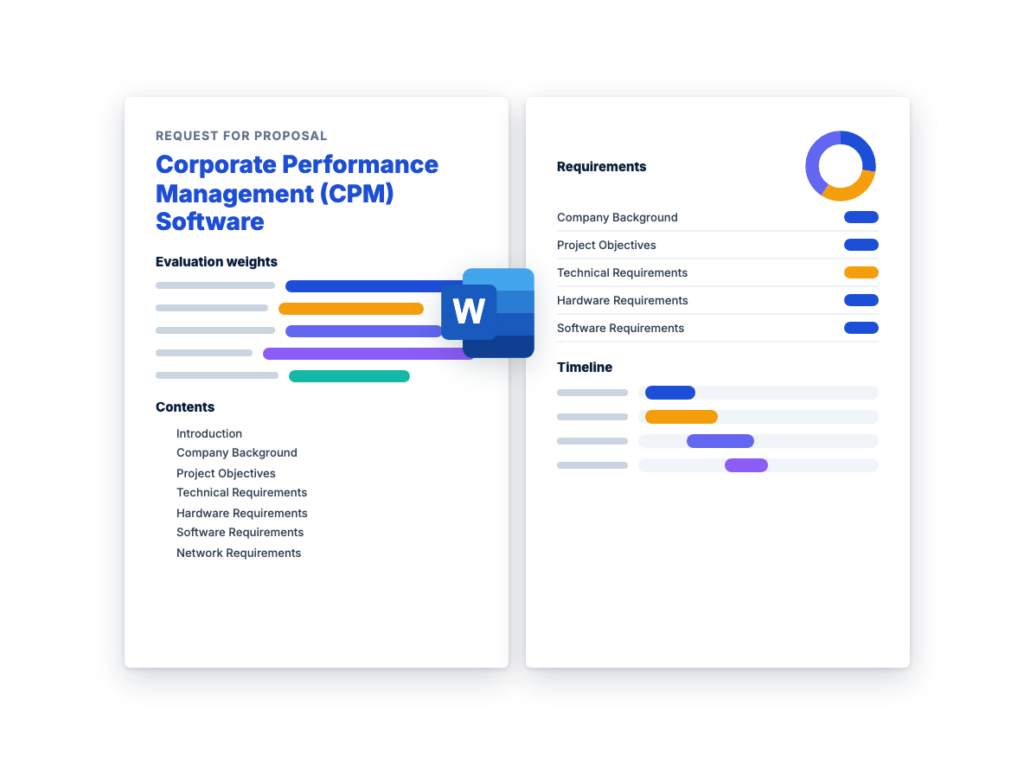
Request for Proposal (RFP): Corporate Performance Management (CPM) Software Solution
Table of Contents
- Introduction
- Company Background
- Project Objectives
- Technical Requirements
- Functional Requirements
- AI and Machine Learning Capabilities
- Implementation and Support
- Pricing Structure
- Vendor Information
- Evaluation Criteria
- Submission Instructions
- RFP Timeline
1. Introduction
This Request for Proposal (RFP) is issued to select a robust Corporate Performance Management (CPM) software solution that will enhance our organization’s ability to monitor, manage, and optimize business performance across all departments.
2. Company Background
[To be completed by the issuing organization with:
- Organization description
- Industry details
- Company size
- Current systems
- Specific needs]
3. Project Objectives
Our primary objectives for implementing a CPM solution are:
3.1. Implement a comprehensive CPM solution to streamline performance management processes
3.2. Enhance strategic planning and execution capabilities
3.3. Improve forecasting and budgeting accuracy
3.4. Facilitate real-time performance monitoring and analysis
3.5. Ensure data consistency and integrity across the organization
4. Technical Requirements
4.1 Hardware Requirements
Server Specifications:
- Processor: Multi-core processor (Intel Core i5 or higher)
- RAM: Minimum 8 GB, preferably 16 GB or more for larger organizations
- Storage: At least 100 GB available disk space, SSDs preferred
Client Specifications:
- Processor: Dual-core processors
- RAM: Minimum 4 GB
- Storage: Sufficient for local installations and temporary files
4.2 Software Requirements
- Operating System compatibility:
- Windows Server (Windows Server 2016 or later)
- Linux distributions (Ubuntu, CentOS)
- Database Management System (DBMS):
- Compatible with Microsoft SQL Server, Oracle Database, or MySQL
- Version requirements to be specified
- Web Browser Compatibility:
- Support for modern browsers (Google Chrome, Mozilla Firefox, Microsoft Edge)
4.3 Network Requirements
- Internet Connection:
- Stable and high-speed internet connection for cloud-based solutions
- Minimum bandwidth specifications
- Network Configuration:
- Proper firewall settings
- VPN configurations for secure data transmission
- Security protocols implementation
4.4 Integration Requirements
- APIs and Middleware:
- Integration with existing systems (ERP, CRM, etc.)
- REST API availability
- SOAP API support where needed
- Custom API development capabilities
4.5 Security Requirements
- Authentication:
- Multi-factor authentication
- Single sign-on (SSO) capabilities
- Active Directory integration
- Data Security:
- End-to-end encryption
- Data encryption at rest
- Secure data transmission protocols
- Compliance:
- GDPR compliance
- HIPAA compliance
- SOC 2 certification
5. Functional Requirements
5.1 Goal Setting and Objective Management
Tip: Essential for organizational alignment and performance tracking, this module should enable clear communication of objectives across all levels while providing tools for measurement, tracking, and adjustment of goals. The system must support both top-down and bottom-up goal setting approaches while maintaining strategic alignment throughout the organization.
| Requirement |
Sub-Requirement |
Y/N |
Notes |
| Goal Definition |
Define corporate goals organization-wide |
|
|
|
Create measurable objectives |
|
|
|
Set realistic performance targets |
|
|
| Goal Alignment |
Align department goals with corporate strategy |
|
|
|
Map dependencies between objectives |
|
|
| Goal Management |
Categorize objectives by priority |
|
|
|
Track goal progress in real-time |
|
|
|
Adjust goals based on performance data |
|
|
5.2 Strategic Planning Tools
Tip: Strategic planning functionality must support comprehensive long-term planning while maintaining flexibility for market changes. The system should integrate scenario planning, resource allocation, and risk assessment capabilities while enabling regular plan updates and performance tracking against strategic objectives.
| Requirement |
Sub-Requirement |
Y/N |
Notes |
| Long-term Planning |
Support merger planning |
|
|
|
Support acquisition planning |
|
|
|
Support expansion planning |
|
|
| Plan Development |
Create strategic plans |
|
|
|
Adjust plans based on feedback |
|
|
|
Link plans to objectives |
|
|
| Resource Management |
Allocate resources effectively |
|
|
|
Track resource utilization |
|
|
| Risk Assessment |
Identify potential risks |
|
|
|
Evaluate risk impact |
|
|
|
Monitor risk mitigation |
|
|
5.3 Forecasting and Budgeting
Tip: Integrate advanced forecasting capabilities with comprehensive budgeting tools to enable accurate financial planning and monitoring. The system should support multiple forecasting methodologies while providing flexible budgeting capabilities that can adapt to changing business conditions and organizational structures.
| Requirement |
Sub-Requirement |
Y/N |
Notes |
| Multi-source Analysis |
Integrate data from multiple sources |
|
|
|
Predict future costs and revenues |
|
|
|
Process historical trends |
|
|
| Budget Creation |
Create aligned corporate budgets |
|
|
|
Enable departmental budgeting |
|
|
|
Support multi-currency budgeting |
|
|
| Scenario Planning |
Perform what-if analysis |
|
|
|
Create multiple forecast scenarios |
|
|
|
Model different business conditions |
|
|
5.4 KPI Management
Tip: Enable comprehensive performance measurement through flexible KPI definition and tracking capabilities. The system must support both standard and custom metrics while providing real-time monitoring, automated data collection, and sophisticated analysis tools to drive performance improvement across all organizational levels.
| Requirement |
Sub-Requirement |
Y/N |
Notes |
| KPI Definition |
Provide pre-defined KPI library |
|
|
|
Support custom KPI creation |
|
|
|
Enable industry-specific metrics |
|
|
| Performance Monitoring |
Real-time KPI tracking |
|
|
|
Automated data collection |
|
|
|
Alert threshold configuration |
|
|
| Comparative Analysis |
Compare actual vs. target |
|
|
|
Track historical performance |
|
|
|
Benchmark against industry standards |
|
|
5.5 Data Integration and Consolidation
Tip: Deliver robust data integration capabilities that ensure seamless information flow across systems while maintaining data integrity. The solution must support multiple data sources, provide strong validation mechanisms, and enable automated data collection while ensuring consistency across the organization.
| Requirement |
Sub-Requirement |
Y/N |
Notes |
| System Integration |
Connect with ERP systems |
|
|
|
Interface with CRM platforms |
|
|
|
Link to accounting systems |
|
|
| Data Management |
Ensure data accuracy |
|
|
|
Maintain data consistency |
|
|
|
Implement validation rules |
|
|
| Automation |
Automate data collection |
|
|
|
Schedule data updates |
|
|
|
Configure data workflows |
|
|
5.6 Financial Consolidation and Reporting
Tip: Support comprehensive financial consolidation across multiple entities, currencies, and accounting standards while providing flexible reporting capabilities. The system must automate complex consolidation processes and deliver both standard and customizable financial reports with real-time data access.
| Requirement |
Sub-Requirement |
Y/N |
Notes |
| Data Consolidation |
Automate financial data collection |
|
|
|
Process intercompany transactions |
|
|
|
Handle multiple accounting standards |
|
|
| Financial Reports |
Generate standard financial statements |
|
|
|
Create custom financial reports |
|
|
|
Support regulatory reporting |
|
|
| Multi-entity Support |
Handle multiple currencies |
|
|
|
Process multiple legal entities |
|
|
|
Manage different fiscal periods |
|
|
5.7 Analytics and Business Intelligence
Tip: Provide advanced analytics and BI capabilities that balance power with usability, enabling users to gain actionable insights from complex data sets. The system should support both standard and ad-hoc analysis while delivering intuitive visualization tools and flexible reporting options.
| Requirement |
Sub-Requirement |
Y/N |
Notes |
| Data Analysis |
Provide advanced analytics tools |
|
|
|
Support predictive analytics |
|
|
|
Enable trend analysis |
|
|
| Visualization |
Create interactive dashboards |
|
|
|
Generate custom charts |
|
|
|
Support data storytelling |
|
|
| Report Generation |
Create standard reports |
|
|
|
Enable ad-hoc reporting |
|
|
|
Support report scheduling |
|
|
5.8 Workflow Automation
Tip: Enable comprehensive workflow automation that streamlines business processes while maintaining appropriate controls and visibility. The system should support complex approval hierarchies, conditional routing, and automated notifications while providing clear status tracking and reporting.
| Requirement |
Sub-Requirement |
Y/N |
Notes |
| Process Automation |
Automate performance tracking |
|
|
|
Configure workflow rules |
|
|
|
Enable conditional routing |
|
|
| Approval Management |
Set up approval hierarchies |
|
|
|
Configure approval rules |
|
|
|
Track approval status |
|
|
| Alert System |
Configure alert triggers |
|
|
|
Set up notification rules |
|
|
|
Enable escalation paths |
|
|
5.9 Compliance and Risk Management
Tip: Integrate comprehensive compliance monitoring with robust risk management capabilities to ensure regulatory adherence and proactive risk mitigation. The system must support automated compliance tracking, risk assessment, and reporting while maintaining audit trails and documentation.
| Requirement |
Sub-Requirement |
Y/N |
Notes |
| Compliance Management |
Integrate with GRC software |
|
|
|
Track regulatory requirements |
|
|
|
Monitor compliance status |
|
|
| Risk Assessment |
Identify business risks |
|
|
|
Evaluate risk impact |
|
|
|
Track risk metrics |
|
|
| Automated Monitoring |
Configure compliance checks |
|
|
|
Set up risk alerts |
|
|
|
Generate compliance reports |
|
|
5.10 User Access Management
Tip: Implement robust access controls that balance security with usability, ensuring appropriate data access while maintaining comprehensive audit trails. The system must support role-based access control, integrate with enterprise authentication systems, and provide detailed activity logging.
| Requirement |
Sub-Requirement |
Y/N |
Notes |
| Access Control |
Implement role-based access |
|
|
|
Configure user permissions |
|
|
|
Manage user groups |
|
|
| Security Features |
Enable data encryption |
|
|
|
Implement authentication controls |
|
|
|
Support SSO integration |
|
|
| Audit Capability |
Track user activities |
|
|
|
Monitor system access |
|
|
|
Generate audit reports |
|
|
5.11 Collaboration Tools
Tip: Enable seamless collaboration across departments through integrated communication and document management capabilities. The system should support team interaction, document sharing, and feedback collection while maintaining version control and audit trails.
| Requirement |
Sub-Requirement |
Y/N |
Notes |
| Communication Tools |
Enable cross-department messaging |
|
|
|
Support team discussions |
|
|
|
Facilitate information sharing |
|
|
| Document Management |
Support version control |
|
|
|
Enable document sharing |
|
|
|
Track document history |
|
|
| Mobile Access |
Provide mobile app access |
|
|
|
Enable remote collaboration |
|
|
|
Support offline capabilities |
|
|
5.12 Scalability and Customization
Tip: Deliver a flexible system that can grow with organizational needs while providing comprehensive customization options. The solution must support increasing data volumes, user counts, and functional requirements while enabling tailored configurations for specific business needs.
| Requirement |
Sub-Requirement |
Y/N |
Notes |
| Customization Options |
Customize reports and dashboards |
|
|
|
Configure workflows |
|
|
|
Modify system parameters |
|
|
| Scalability Features |
Support user growth |
|
|
|
Handle increased data volume |
|
|
|
Enable system expansion |
|
|
| Industry Support |
Provide industry templates |
|
|
|
Support sector-specific needs |
|
|
|
Enable best practices |
|
|
5.13 Sustainability Reporting
Tip: Provide comprehensive ESG reporting capabilities with automated data collection and metric tracking. The system must support various sustainability frameworks while enabling efficient data gathering and accurate performance monitoring against environmental and social goals.
| Requirement |
Sub-Requirement |
Y/N |
Notes |
| ESG Reporting |
Generate ESG reports |
|
|
|
Track sustainability metrics |
|
|
|
Monitor environmental impact |
|
|
| Data Collection |
Automate ESG data gathering |
|
|
|
Validate sustainability data |
|
|
|
Track data sources |
|
|
| Performance Monitoring |
Monitor ESG performance |
|
|
|
Track progress over time |
|
|
|
Compare against targets |
|
|
5.14 Process Modeling
Tip: Enable comprehensive process design and optimization through intelligent modeling capabilities. The system should support both standard and custom process models while providing recommendations for improvement and performance optimization.
| Requirement |
Sub-Requirement |
Y/N |
Notes |
| Process Design |
Model business processes |
|
|
|
Configure process flows |
|
|
|
Define process rules |
|
|
| Optimization |
Recommend improvements |
|
|
|
Monitor process efficiency |
|
|
|
Track optimization metrics |
|
|
| Template Management |
Use preconfigured models |
|
|
|
Customize process templates |
|
|
|
Share best practices |
|
|
6. AI and Machine Learning Capabilities
6.1 Ask AI (Generative AI Assistant)
Tip: Implement an advanced AI assistant that provides natural language interaction for data analysis and reporting. The system must understand complex queries, provide contextual responses, and support both text and voice input while maintaining accuracy and relevance in financial analysis.
| Requirement |
Sub-Requirement |
Y/N |
Notes |
| Natural Language |
Process text queries |
|
|
|
Handle voice commands |
|
|
|
Understand context |
|
|
| Response Generation |
Provide visual responses |
|
|
|
Generate text explanations |
|
|
|
Create interactive replies |
|
|
| Data Analysis |
Process financial data |
|
|
|
Analyze reports |
|
|
|
Generate insights |
|
|
6.2 Intelligent Analytics
Tip: Deliver sophisticated analytics capabilities that combine ease of use with advanced processing power. The system should enable self-service analysis while providing automated insights and supporting complex data exploration through intuitive interfaces.
| Requirement |
Sub-Requirement |
Y/N |
Notes |
| Self-Service |
Enable report creation |
|
|
|
Support ad-hoc analysis |
|
|
|
Provide data exploration |
|
|
| Dashboard Creation |
Build custom dashboards |
|
|
|
Create visualizations |
|
|
|
Enable interactivity |
|
|
| Data Search |
Implement quick search |
|
|
|
Enable advanced filtering |
|
|
|
Support natural language search |
|
|
6.3 AI Automapping
Tip: Provide intelligent data mapping capabilities that streamline integration processes while maintaining data governance standards. The system must automatically identify and map data elements across systems while ensuring accuracy and compliance.
| Requirement |
Sub-Requirement |
Y/N |
Notes |
| Data Mapping |
Automate source mapping |
|
|
|
Handle multiple formats |
|
|
|
Validate mappings |
|
|
| Governance |
Enforce data rules |
|
|
|
Maintain audit trails |
|
|
|
Ensure compliance |
|
|
| Integration |
Connect data sources |
|
|
|
Handle transformations |
|
|
|
Manage updates |
|
|
6.4 AI Anomaly Detection
Tip: Enable sophisticated anomaly detection through multiple AI algorithms that identify irregular patterns while minimizing false positives. The system should automatically detect and flag unusual data patterns while providing clear explanations and supporting evidence.
| Requirement |
Sub-Requirement |
Y/N |
Notes |
| Detection Methods |
Identify outliers |
|
|
|
Detect patterns |
|
|
|
Monitor trends |
|
|
| Data Integrity |
Validate data quality |
|
|
|
Check consistency |
|
|
|
Ensure completeness |
|
|
| Error Prevention |
Reduce reporting errors |
|
|
|
Prevent data issues |
|
|
|
Flag potential problems |
|
|
6.5 Intelligent Disclosure
Tip: Support comprehensive reporting through AI-driven content generation and data integration. The system must automatically combine financial and non-financial data while generating clear narratives and maintaining accuracy in regulatory disclosures.
| Requirement |
Sub-Requirement |
Y/N |
Notes |
| Data Integration |
Combine financial data |
|
|
|
Include ESG information |
|
|
|
Merge multiple sources |
|
|
| Report Generation |
Create dynamic reports |
|
|
|
Generate narratives |
|
|
|
Link data sources |
|
|
| Quality Control |
Validate content |
|
|
|
Ensure accuracy |
|
|
|
Check consistency |
|
|
6.6 AI Driver-Based Analysis
Tip: Deliver advanced analytics capabilities that identify and analyze key business drivers through machine learning algorithms. The system should process large datasets to uncover relationships between variables and provide actionable insights for business optimization.
| Requirement |
Sub-Requirement |
Y/N |
Notes |
| Data Analysis |
Process large datasets |
|
|
|
Identify key drivers |
|
|
|
Analyze relationships |
|
|
| Growth Analysis |
Find opportunities |
|
|
|
Assess potential |
|
|
|
Evaluate impact |
|
|
| Insights |
Generate recommendations |
|
|
|
Create visualizations |
|
|
|
Provide explanations |
|
|
6.7 Predictive Intelligence
Tip: Enable sophisticated forecasting through advanced machine learning models while maintaining transparency in predictions. The system must generate explainable forecasts, support strategic planning, and provide clear confidence levels for all predictions.
| Requirement |
Sub-Requirement |
Y/N |
Notes |
| Forecasting |
Generate predictions |
|
|
|
Explain forecasts |
|
|
|
Update in real-time |
|
|
| Decision Support |
Provide recommendations |
|
|
|
Guide planning |
|
|
|
Assess risks |
|
|
| Model Management |
Update models |
|
|
|
Validate accuracy |
|
|
|
Track performance |
|
|
6.8 Real-Time Performance Adjustments
Tip: Implement dynamic performance optimization through continuous AI-driven monitoring and automated adjustments. The system should analyze performance metrics in real-time and suggest or implement improvements while maintaining operational stability.
| Requirement |
Sub-Requirement |
Y/N |
Notes |
| Monitoring |
Track real-time metrics |
|
|
|
Analyze performance |
|
|
|
Detect anomalies |
|
|
| Adjustments |
Recommend changes |
|
|
|
Implement updates |
|
|
|
Track impact |
|
|
| Reporting |
Generate alerts |
|
|
|
Document changes |
|
|
|
Measure effectiveness |
|
|
6.9 Automated Performance Analytics
Tip: Provide comprehensive automated analysis of performance metrics through AI algorithms. The system must automatically generate insights, identify trends, and suggest improvements while maintaining accuracy and relevance in analysis.
| Requirement |
Sub-Requirement |
Y/N |
Notes |
| Analysis |
Generate metrics |
|
|
|
Calculate KPIs |
|
|
|
Track trends |
|
|
| Automation |
Schedule analysis |
|
|
|
Update metrics |
|
|
|
Generate reports |
|
|
| Insights |
Identify patterns |
|
|
|
Suggest improvements |
|
|
|
Prioritize actions |
|
|
6.10 AI-Powered Scenario Planning
Tip: Enable comprehensive scenario analysis through AI-driven modeling and simulation. The system should support the creation and evaluation of multiple business scenarios while providing clear insights into potential outcomes and implications.
| Requirement |
Sub-Requirement |
Y/N |
Notes |
| Scenario Creation |
Build scenarios |
|
|
|
Model assumptions |
|
|
|
Configure variables |
|
|
| Analysis |
Evaluate outcomes |
|
|
|
Calculate probabilities |
|
|
|
Assess risks |
|
|
| Reporting |
Compare scenarios |
|
|
|
Document results |
|
|
|
Track performance |
|
|
6.11 Intelligent Resource Allocation
Tip: Optimize resource distribution through AI-driven analysis and recommendations. The system must evaluate resource needs, suggest optimal allocations, and continuously monitor utilization while adapting to changing business conditions and constraints.
| Requirement |
Sub-Requirement |
Y/N |
Notes |
| Resource Analysis |
Evaluate needs |
|
|
|
Track utilization |
|
|
|
Identify inefficiencies |
|
|
| Optimization |
Generate recommendations |
|
|
|
Balance resources |
|
|
|
Maximize efficiency |
|
|
| Monitoring |
Track allocation |
|
|
|
Measure performance |
|
|
|
Adjust distribution |
|
|
6.12 AI-Assisted Process Analyzer
Tip: Deliver intuitive process analysis through natural language interaction and advanced AI algorithms. The system should understand complex queries about process performance and provide immediate, actionable insights for optimization.
| Requirement |
Sub-Requirement |
Y/N |
Notes |
| Query Processing |
Handle natural language |
|
|
|
Understand context |
|
|
|
Process complex questions |
|
|
| Analysis |
Generate insights |
|
|
|
Identify bottlenecks |
|
|
|
Suggest improvements |
|
|
| Reporting |
Provide real-time answers |
|
|
|
Create visualizations |
|
|
|
Document findings |
|
|
6.13 AI-Powered Integration Flow
Tip: Enable automated integration development through natural language instructions and machine learning. The system must generate reliable integration flows while maintaining proper error handling and performance optimization.
| Requirement |
Sub-Requirement |
Y/N |
Notes |
| Flow Creation |
Generate integrations |
|
|
|
Handle complex scenarios |
|
|
|
Optimize performance |
|
|
| Configuration |
Set up connections |
|
|
|
Define parameters |
|
|
|
Establish rules |
|
|
| Management |
Monitor flows |
|
|
|
Handle errors |
|
|
|
Maintain performance |
|
|
6.14 AI-Enabled Visual Inspection
Tip: Support comprehensive visual analysis of performance data and operational metrics. The system must process visual information to identify patterns, detect anomalies, and provide insights for performance optimization.
| Requirement |
Sub-Requirement |
Y/N |
Notes |
| Visual Analysis |
Process performance data |
|
|
|
Detect patterns |
|
|
|
Identify anomalies |
|
|
| Monitoring |
Track operations |
|
|
|
Assess conditions |
|
|
|
Generate alerts |
|
|
| Reporting |
Create visual reports |
|
|
|
Document findings |
|
|
|
Track resolutions |
|
|
6.15 Natural Language Explanations
Tip: Generate clear, contextual explanations of complex financial concepts and analysis results. The system must provide accurate, understandable explanations while adapting to different user expertise levels.
| Requirement |
Sub-Requirement |
Y/N |
Notes |
| Content Generation |
Explain concepts |
|
|
|
Provide context |
|
|
|
Generate documentation |
|
|
| Customization |
Adapt to user level |
|
|
|
Adjust complexity |
|
|
|
Support multiple formats |
|
|
| Quality |
Ensure accuracy |
|
|
|
Validate content |
|
|
|
Maintain consistency |
|
|
7. Implementation and Support
7.1 Implementation Requirements
- Detailed implementation methodology
- Project timeline with key milestones
- Resource allocation plan
- Risk management strategy
- Change management approach
- Testing and validation procedures
- Data migration strategy
- User acceptance testing plan
7.2 Training Requirements
- Comprehensive training program for administrators
- End-user training materials and sessions
- Online training resources and documentation
- Hands-on workshops and practice environments
- Knowledge transfer to internal support team
- Ongoing training for new features and updates
7.3 Support Services
- 24/7 technical support availability
- Multiple support channels (phone, email, chat)
- Service Level Agreement (SLA) specifications
- Escalation procedures
- Regular maintenance schedule
- Emergency support protocol
- Bug fixing and patch management
- Version upgrade support
8. Pricing Structure
8.1 License Costs
- Software licensing model details
- Per-user pricing structure
- Module-based pricing
- Volume discounts
- Additional user license costs
- Enterprise licensing options
8.2 Implementation Costs
- Project management fees
- Installation and configuration costs
- Data migration costs
- Integration development expenses
- Testing and validation costs
- Documentation costs
- Training program costs
- Travel and expenses if required
8.3 Ongoing Costs
- Annual maintenance fees
- Support package costs
- Update and upgrade fees
- Additional storage costs
- Backup and recovery costs
- Additional environment costs (development, testing)
- Additional customization costs
9. Vendor Information
9.1 Company Profile
- Company history and background
- Financial stability indicators
- Global presence and operations
- Number of employees
- Organizational structure
- Key executive team
- Research and development investment
9.2 Experience and Expertise
- Years in CPM software industry
- Number of successful implementations
- Industry-specific experience
- Client portfolio
- Partnership networks
- Technology certifications
- Innovation track record
9.3 Client References
- Minimum three client references
- Similar industry implementations
- Contact information for references
- Case studies
- Success stories
- Customer satisfaction metrics
10. Evaluation Criteria
10.1 Technical Evaluation (30%)
- Functionality completeness
- Technical requirements compliance
- Integration capabilities
- Performance and scalability
- Security features
- Innovation and technology
10.2 Implementation and Support (25%)
- Implementation methodology
- Project team expertise
- Training capabilities
- Support services
- Documentation quality
- Change management approach
10.3 Vendor Capability (20%)
- Company stability
- Industry experience
- Reference checks
- Resource availability
- Geographic presence
- Partnership ecosystem
10.4 Commercial (25%)
- Total cost of ownership
- Pricing model
- Payment terms
- Value for money
- Additional costs
- Contract flexibility
11. Submission Instructions
11.1 Proposal Format
- Executive summary
- Technical response
- Implementation approach
- Pricing details
- Company information
- Client references
- Additional documentation
11.2 Submission Requirements
- Submission deadline: [Date and Time]
- Number of copies: [X] digital copies
- Proposal format: PDF format
- Maximum page limit: [X] pages
- File naming convention: [Convention]
- Submission method: [Email/Portal]
11.3 Communication Protocol
- Primary contact: [Name and Title]
- Email address: [Email]
- Phone number: [Phone]
- Questions deadline: [Date]
- Response format for questions
- Communication restrictions
12. RFP Timeline
12.1 Key Dates
- RFP Release Date: [Date]
- Questions Submission Deadline: [Date]
- Responses to Questions: [Date]
- Proposal Submission Deadline: [Date]
- Initial Evaluation Completion: [Date]
- Vendor Presentations: [Date Range]
- Final Selection: [Date]
- Contract Negotiation: [Date Range]
- Project Kickoff: [Date]
12.2 Selection Process
- Initial proposal screening
- Technical evaluation
- Vendor presentations
- Reference checks
- Commercial evaluation
- Final selection
- Contract negotiation
- Award announcement
12.3 Post-Award Schedule
- Contract signing: [Date]
- Project planning: [Date Range]
- Implementation start: [Date]
- Go-live target: [Date]
Related RFP templates
Download Template