FedRAMP Assessment RFQ Template (Free): 3PAO Quotes
A free FedRAMP assessment RFQ for quotes from FedRAMP Recognized assessors (formerly 3PAOs): paste-ready requirements for scope, team, independence and pricing, plus…
Word · FreeDownload Template →
Paste-ready digital risk protection requirements (lookalike domains, phishing, social and app impersonation, leaked credentials, dark web, takedown), vendor questions and a weighted scoring rubric.
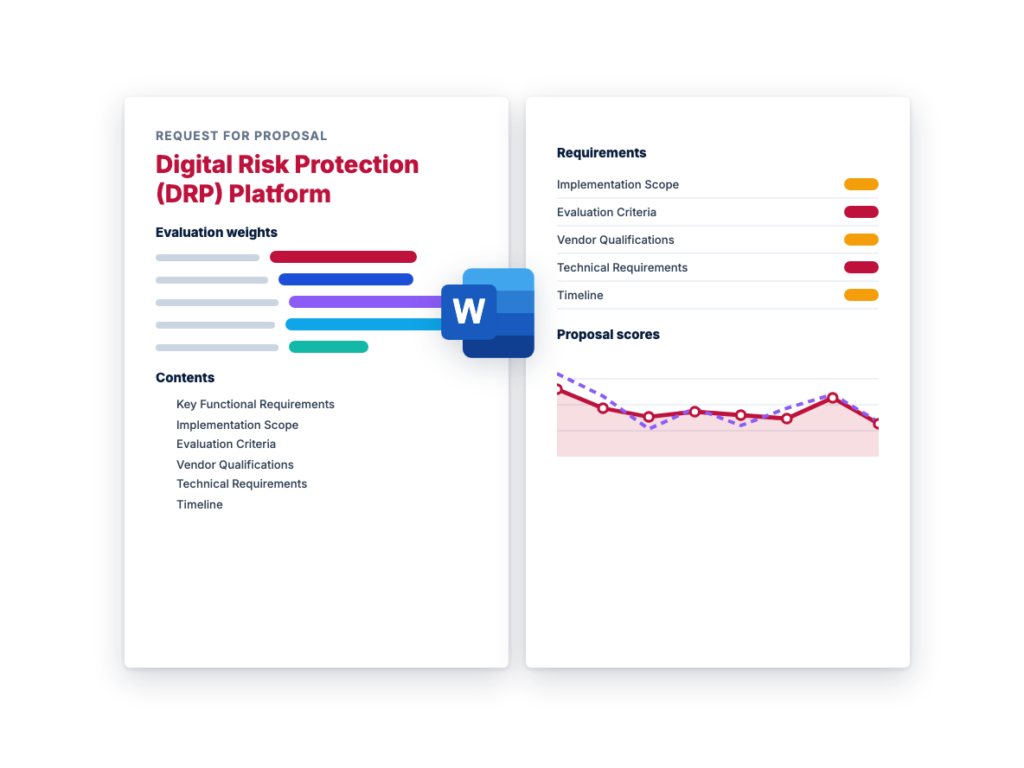
See the structure before you download. The Word file has every section listed below, ready to fill in.
The sections in the document, in order.
Use this digital risk protection RFP template when you need to find and remove threats to your organization that sit outside your network: lookalike domains and phishing sites, fake social media accounts and apps, impersonation of your executives, leaked credentials and data, and mentions of your organization on criminal forums and leak sites.
It's written for the security, threat intelligence, brand and fraud team running the evaluation, and it covers the whole process: when to issue an RFI first, the requirements to send, the questions that separate vendors, and how to score the answers.
Digital risk protection (DRP) is often sold today as part of a threat intelligence offering or alongside external attack surface management (EASM), and takedown is commonly delivered by the vendor's analysts as a service, so the template asks vendors to say which parts are software and which are people.
Download the editable Microsoft Word version below. Every requirement, vendor question and scoring weight on this page is in the document, ready to tailor and send.
A digital risk protection evaluation works best when vendors run against your own brands rather than demo data, and when legal and privacy are involved from the start, because the service monitors named people and acts in your name. The example schedule in this template runs about 11 weeks from kickoff to contract award; allow more if you have many brands or regions, or if executive monitoring needs consent from each person.
Each line is written to paste straight into your RFP. Must-have means a vendor that cannot meet it is out; Nice-to-have earns extra points. Change the priorities to fit your situation, and delete what doesn't apply.
| ID | Requirement | Priority |
|---|---|---|
| F1 | A monitored asset profile that we control: brands, trademarks and logos, official domains, social media accounts, mobile apps, executives and other named people, product names, IP ranges and keywords, with vendor help to build it and to find official domains and accounts we may have missed. | Must-have |
| F2 | Detection of domains that imitate ours, both newly registered and existing: typosquatting, character swaps, homoglyphs and internationalized domain names (IDN), and our brand names combined with words such as 'login' or 'support', across generic and country-code top-level domains. State the sources used (such as domain registration data and certificate transparency logs) and how soon after registration a new domain is detected. | Must-have |
| F3 | For each suspicious domain: DNS records (including mail exchange records that show it can send or receive email), hosting provider, registration data, TLS certificates, a screenshot and saved copy of any page, and comparison with our logos and login pages, plus continued monitoring of parked or inactive domains with an alert when their content or DNS records change. | Must-have |
| F4 | Detection of phishing pages, cloned websites and scam sites that use our brand, including pages hosted on subdomains of free hosting, cloud storage and website-builder services rather than on lookalike domains. | Must-have |
| F5 | Detection of copies of our websites through a tag or script on our own pages that reports when a page is loaded from an unexpected domain. State exactly what the code collects and how it is secured. | Nice-to-have |
| F6 | Detection of social media accounts, pages and profiles that impersonate our brand, our executives or our customer support, on the platforms we name [list], matched on names, handles, profile images and logos. State how each platform is monitored. | Must-have |
| F7 | Detection of paid search and social media ads that use our brand or our executives' names to send people to phishing, scam or counterfeit sites. | Nice-to-have |
| F8 | Detection of mobile apps that imitate ours or misuse our brand, in official app stores, third-party app stores and download sites, including modified copies of our own apps. | Must-have |
| F9 | Monitoring of online marketplaces for counterfeit goods and unauthorized sellers using our trademarks. Make this Must-have if you sell physical products. | Nice-to-have |
| F10 | Detection of leaked employee and customer credentials for our domains from breach collections, paste sites, criminal forums and infostealer malware logs, showing the source, the date found, and whether the record includes a plaintext password, session cookies or details of the infected device. State how soon after collection new infostealer logs are processed. | Must-have |
| F11 | Detection of our documents, customer data, source code and secrets (such as API keys and access tokens) exposed on paste sites, public code repositories, file-sharing services and open cloud storage, matched on keywords, code identifiers and document markers we supply. | Must-have |
| F12 | Monitoring of criminal forums, marketplaces, messaging channels and ransomware data leak sites for mentions of our organization, brands, domains and executives, including offers to sell access to our network or data, with translation of posts in other languages and the original text kept as evidence. | Must-have |
| F13 | Monitoring of our key suppliers and partners [list] for mentions on ransomware data leak sites and criminal channels, and for leaked credentials on their domains that could give access to our systems or data. | Nice-to-have |
| F14 | Executive protection: monitoring for exposure of named people's personal information (home addresses, personal phone numbers and email addresses, family details) on people-search and data broker sites, paste sites and forums, with removal requests where the site offers them. Set up only with each person's written consent. | Nice-to-have |
| F15 | Detection of AI-generated images, audio or video that impersonate our executives or brand on social media and video platforms. State the detection method, the platforms covered, and whether the capability is generally available today. | Nice-to-have |
| F16 | Validation of alerts by the vendor's analysts before they reach us, for the alert types we choose, plus a severity rating with the reasons shown, grouping of related findings (for example, many domains from one phishing campaign), and a way for our analysts to mark false positives and tune detection. | Must-have |
| F17 | Evidence with every alert: timestamped screenshots, saved page content, URLs, registration and hosting data, DNS records and the asset or rule that matched, kept for the contract term and exportable in a form suitable for legal action and law-enforcement referrals. | Must-have |
| F18 | Takedown of confirmed threats: requests sent to registrars, hosting providers, social media platforms, app stores and marketplaces after our approval, or automatically for categories we pre-approve, with each request's status tracked and escalated when a provider doesn't respond. State which channels are covered, and which steps are done by vendor staff, done automatically or left to us. | Must-have |
| F19 | Submission of confirmed phishing URLs and domains to browser and security-industry blocklists, so they are blocked for the public while the takedown is in progress. | Must-have |
| F20 | Re-checks of removed sites, accounts and apps after takedown, with an alert when one reappears and a link to the earlier case. | Must-have |
| F21 | Dashboards and scheduled reports showing open threats by type, severity and brand, takedown status, the time from detection to takedown request and to removal, and trends over time, plus an executive summary for leadership. | Must-have |
| ID | Requirement | Priority |
|---|---|---|
| T1 | Delivery as a cloud service, with a choice of the region where our findings, evidence and the personal data they contain are stored, to meet data-residency requirements. | Must-have |
| T2 | A description of collection coverage for each source type (domain registration and certificate data, web crawling, social media, app stores, paste sites, code repositories, criminal forums and marketplaces, messaging channels, leak sites and infostealer logs): how it is collected, how often, which languages and regions are covered, and which sources the vendor collects itself and which it licenses from third parties. | Must-have |
| T3 | Search of historical collections, such as past breach data and archived forum posts, for our assets and keywords, with the lookback period stated for each source type. | Must-have |
| T4 | Separate workspaces or profiles for our brands, business units and subsidiaries, each with its own users, alert routing and reports, plus a combined view for the central security team. | Must-have |
| T5 | Published limits on monitored assets, keywords, users and API calls in the proposed edition, and confirmation that the proposal covers our volumes [brands, domains, executives, apps, keywords]. | Must-have |
| T6 | AI features, such as alert summaries, triage suggestions or image matching, with a statement of where the models run, what data they see, whether our data is used for training, and an administrator setting to turn them off. | Nice-to-have |
| ID | Requirement | Priority |
|---|---|---|
| I1 | Single sign-on with our identity provider via SAML 2.0 or OIDC, with user and group provisioning via SCIM. | Must-have |
| I2 | A documented REST API and webhooks covering alerts, evidence and takedown status, plus streaming of alerts and audit logs to our SIEM in a documented format, such as syslog with CEF or JSON. | Must-have |
| I3 | Integration with our SOAR and ticketing (ITSM) tools: creation and update of tickets with two-way status sync, and API actions our playbooks can call, such as approving a takedown or closing an alert. | Must-have |
| I4 | Export of confirmed malicious domains, URLs and IP addresses as indicators to our threat intelligence platform, email security, secure web gateway, DNS filtering and firewalls, via STIX 2.1 over TAXII 2.1 or a documented feed, with expiry rules we can set. | Must-have |
| I5 | Matching of leaked credentials against active accounts in our directory, and triggering of password resets and session revocation through our identity provider or SOAR, with an approval step before any account is changed. | Nice-to-have |
| I6 | Notifications to email and our team chat tools, routed by alert type, severity, brand and business unit. | Nice-to-have |
| ID | Requirement | Priority |
|---|---|---|
| S1 | A current SOC 2 Type II report and ISO/IEC 27001 certification covering the proposed platform and managed services, available under NDA. | Must-have |
| S2 | Isolation of our tenant's data, encryption in transit and at rest, and a documented key-management approach. | Must-have |
| S3 | User access through SSO with MFA, role-based permissions that can limit who sees leaked credentials and executives' personal information, and an audit log of logins, configuration changes, evidence exports and takedown approvals. | Must-have |
| S4 | Protection of sensitive findings: leaked passwords and session cookies masked by default and shown only to permitted roles, with each reveal logged, and retention and deletion rules we set for personal data in findings. | Must-have |
| S5 | A written description of how the vendor collects from criminal sources, confirming that it does not access systems or accounts without authorization, stating its policy on engaging with threat actors and on buying stolen data, and explaining how its research avoids revealing our interest in a source. | Must-have |
| S6 | Takedown requests sent in our name only within the authority we grant, using wording we have approved, with a copy of every request kept. Trademark, copyright or other legal claims are made only for the categories and assets we have approved in advance. | Must-have |
| S7 | A data processing agreement, a current list of sub-processors, support for our privacy obligations (findings contain personal data about employees, customers and executives, and monitoring named people may need their consent or another legal basis), and a contractual commitment to notify us of security incidents affecting our data within a defined time. State the time. | Must-have |
| S8 | Background checks and confidentiality agreements for vendor analysts who handle our findings, and a list of the countries they work from. | Nice-to-have |
| ID | Requirement | Priority |
|---|---|---|
| M1 | An onboarding plan covering our asset profile, keyword and rule tuning, an initial sweep for existing exposures with triage of what it finds, and alert routing, with named roles and the effort expected from both sides. | Must-have |
| M2 | A list of what the vendor needs from us before it can send takedowns (for example, a letter of authorization, trademark registrations and proof of domain ownership), and how soon after contract signature takedowns can start. | Must-have |
| M3 | Identification of who delivers the managed service (vendor staff, partners or both), the hours analysts cover, the languages they work in, and how urgent cases such as an active phishing campaign are handled outside those hours. | Must-have |
| M4 | A service-level agreement for platform availability with service credits, plus stated targets for the time from detection to alert for high-severity findings and from our approval to a takedown request being sent. State which targets are contractual and how they are measured. | Must-have |
| M5 | Support with response-time targets by severity level. State the support hours and targets. | Must-have |
| M6 | A named analyst or customer success contact, [monthly] service reviews covering findings, false positives, takedown outcomes and tuning changes, and training for our analysts and administrators. | Must-have |
| M7 | Advance notice of changes to sources, detection logic or the API that affect what we receive, with a deprecation period for API changes. | Must-have |
| ID | Requirement | Priority |
|---|---|---|
| C1 | Pricing broken down by module (for example, domains and phishing, social media, mobile apps, credentials, data leakage, dark web, executive protection), metric (per brand, domain, executive or monitored asset) and term, showing list price, discount and net price. | Must-have |
| C2 | Takedown pricing: whether takedowns are unlimited, included up to a set number, or charged per takedown; how a takedown is counted (per URL, domain, account or app); the price of extra takedowns; and whether blocklist submissions and repeat takedowns of the same threat count. | Must-have |
| C3 | Prices for adding brands, executives, assets or modules mid-term, co-terminated with the main agreement, and the terms that apply if we exceed the limits of the proposed edition. | Must-have |
| C4 | A cap on price increases at renewal, covering the platform, modules and managed services. State the cap. | Must-have |
| C5 | A proof of value at no charge, run against our own brands for [30] days, with the findings ours to keep. | Nice-to-have |
| C6 | Exit terms covering export of all findings, evidence and takedown records in a documented format, completion or handover of open takedown requests, and deletion of our data, confirmed in writing, at the end of the contract. | Must-have |
These questions are designed to separate vendors, not to collect brochure answers. Ask for evidence: a demo, a document or a reference.
Score each criterion from 1 to 5, multiply by its weight, and add the results. The weights below are a starting point; agree on your own before any proposals arrive so the scoring can't be bent around a favorite.
| Criterion | Weight | What a strong response shows |
|---|---|---|
| Detection coverage across channels | 20% | Every Must-have channel covered in a generally available release, your own brands, domains and executives found in the proof of value, and sources described in writing. |
| Alert quality and evidence | 15% | Few false positives in the proof of value, clear reasons for each severity rating, related findings grouped, and evidence complete enough for a takedown or legal referral. |
| Takedown and disruption | 20% | Takedowns across the channels you need, timing data by channel from the vendor's own records, blocklist submission, monitoring for reappearance, and clear rules on what needs your approval. |
| Integration and workflow | 10% | Alerts, evidence and indicators flowing into your SIEM, SOAR, ticketing and blocking controls, usable APIs, and credential findings your identity team can act on. |
| Collection practices, privacy and security | 10% | A clear, lawful account of how criminal sources are collected, controls on who sees leaked credentials and personal data, and current certifications. |
| Managed service, onboarding and support | 10% | Named analysts with stated hours and languages, a credible onboarding sweep and tuning plan, and clear support targets. |
| Commercials and total cost | 15% | Transparent module and takedown pricing, clear limits, a renewal cap, and a three-year view that includes your expected takedown volume. |
| Total | 100% |
Scoring scale
The assets you need protected (brands, domains, executives, apps and data) and the channels to monitor; requirements for lookalike domain and phishing detection, social media and app impersonation, leaked credentials and data, dark web monitoring, alert evidence and takedown, each marked Must-have or Nice-to-have; questions about collection practices, alert quality and takedown speed; security, privacy and support terms; a pricing table that shows how takedowns are charged; and the rubric you'll score with. This template includes all of them.
Digital risk protection (DRP) looks for threats to your organization on assets you don't own: lookalike domains, phishing sites, fake accounts and apps, leaked credentials and data, and mentions on criminal sources, and it often includes takedown support. External attack surface management (EASM) finds and assesses internet-facing assets you do own, such as forgotten subdomains and exposed services. Threat intelligence covers the wider threat landscape: actors, campaigns and indicators. The three are often sold together, so decide which you're buying and ask for separate prices.
Often, but how it works varies: some vendors' analysts handle the whole process, some automate requests for common cases, and some provide evidence for your own team to submit. A vendor can ask registrars, hosting providers, platforms and app stores to remove content, but those providers make the decision, so no vendor can guarantee a removal or its timing. Ask how takedowns are counted and priced, what authorization the vendor needs from you, and when a case needs your own counsel, such as a domain dispute under the UDRP.
They depend on where you and the people being monitored are, so involve legal counsel and your privacy team before you sign. Settle whether monitoring executives' personal information needs their consent, how leaked credentials and other personal data in findings are stored and deleted, what the vendor may say in takedown requests sent in your name, and how it collects from criminal sources, including whether it ever buys stolen data. This template includes a requirement on each point, but it isn't legal advice.
The example schedule in this template runs about 11 weeks from kickoff to contract award, including three weeks for vendor responses and three to four weeks for a proof of value against your own brands. Allow more time if you have many brands or regions, if executives need to consent to monitoring, or if legal review of takedown authority is new to your organization.
A free FedRAMP assessment RFQ for quotes from FedRAMP Recognized assessors (formerly 3PAOs): paste-ready requirements for scope, team, independence and pricing, plus…
Paste-ready passwordless authentication requirements (synced and device-bound passkeys, FIDO2 security keys, enrollment, recovery, desktop sign-in, legacy apps), vendor questions and a scoring…
Paste-ready penetration testing requirements (scope, named testers, rules of engagement, report, retest, data handling and pricing), questions that separate pen test providers,…
Please provide your feedback below.
"*" indicates required fields