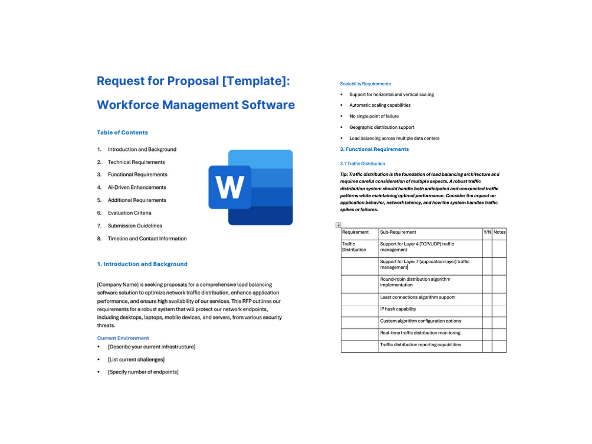
Request for Proposal: Workforce Management Software Solution
Table of Contents
- Introduction and Background
- Project Objectives
- Scope of Work
- Technical Requirements
- Functional Requirements
- Artificial Intelligence Features
- Vendor Qualifications
- Evaluation Criteria
- Submission Guidelines
- Timeline
1. Introduction and Background
[Company Name] is seeking proposals for a comprehensive workforce management software solution to optimize and streamline our workforce operations. This RFP outlines our requirements for a robust system that will manage labor forecasting, scheduling, time and attendance tracking, and other essential workforce management functions.
2. Project Objectives
The primary objectives of this project are to implement a comprehensive workforce management solution that:
3. Scope of Work
The selected vendor will be responsible for:
- Providing a comprehensive workforce management software solution
- Implementing and integrating the solution with existing systems
- Providing training and documentation
- Offering ongoing support and maintenance
- Ensuring system security and data protection
4. Technical Requirements
The solution must provide:
- Cloud-based deployment option
- Mobile device support
- Browser compatibility
- Integration capabilities with existing systems
- Robust security features
- Scalability for future growth
5. Functional Requirements
5.1 Labor Forecasting and Demand Planning
Tip: An effective labor forecasting system is crucial for optimizing workforce allocation and controlling costs. The solution should leverage historical data analysis combined with real-time metrics to predict staffing needs accurately. Key considerations include the ability to handle seasonal variations, special events, and changing business patterns.
| Requirement |
Sub-Requirement |
Y/N |
Notes |
| Labor Forecasting |
Predict staffing needs based on historical data |
|
|
|
Develop workforce contingency plans |
|
|
|
Generate demand-based staffing models |
|
|
|
Analyze peak period requirements |
|
|
5.2 Shift Scheduling and Management
Tip: The scheduling system must balance complex requirements including employee availability, skills, labor laws, and business demands. Look for solutions offering both automated and manual scheduling capabilities, with built-in conflict resolution and real-time adjustment features.
| Requirement |
Sub-Requirement |
Y/N |
Notes |
| Schedule Creation |
Create and modify employee schedules |
|
|
|
Handle complex scheduling rules |
|
|
|
Support multiple shift patterns |
|
|
|
Automated schedule generation |
|
|
| Schedule Management |
Conflict detection and resolution |
|
|
|
Shift swapping capabilities |
|
|
|
Break and meal period planning |
|
|
| Notifications |
Automated notifications for shifts |
|
|
|
Real-time schedule updates |
|
|
5.3 Time and Attendance Tracking
Tip: Accurate time and attendance tracking is essential for payroll accuracy and labor law compliance. The system should support multiple time capture methods while providing real-time visibility into attendance patterns.
| Requirement |
Sub-Requirement |
Y/N |
Notes |
| Time Tracking |
Accurate recording of work hours |
|
|
|
Multiple time entry methods support |
|
|
|
Real-time attendance monitoring |
|
|
| Integration |
Time clock systems integration |
|
|
|
Biometric device support |
|
|
|
Mobile time tracking capabilities |
|
|
| Reporting |
Attendance pattern analysis |
|
|
|
Time card approval workflows |
|
|
5.4 Leave and Absence Management
Tip: A comprehensive leave management system should automate the entire leave lifecycle while handling multiple leave types and complex accrual rules. The solution must maintain compliance with labor laws and company policies.
| Requirement |
Sub-Requirement |
Y/N |
Notes |
| Leave Administration |
Submit and approve PTO requests |
|
|
|
Multiple leave type support |
|
|
|
Leave balance tracking |
|
|
|
Accrual calculations |
|
|
| Compliance |
FMLA tracking |
|
|
|
Policy enforcement |
|
|
|
Leave eligibility verification |
|
|
| Reporting |
Leave usage analysis |
|
|
|
Absence pattern detection |
|
|
5.5 Skills and Competency Management
Tip: An effective skills management system should maintain a comprehensive database of employee capabilities while facilitating skill-based scheduling and development planning. The solution should help identify skill gaps and track certifications.
| Requirement |
Sub-Requirement |
Y/N |
Notes |
| Skills Database |
Employee skills tracking |
|
|
|
Certification management |
|
|
|
Qualification tracking |
|
|
| Skills Matching |
Skills-job requirement matching |
|
|
|
Skill gap analysis |
|
|
|
Training needs identification |
|
|
| Development |
Career path mapping |
|
|
|
Training program tracking |
|
|
5.6 Workforce Analytics and Reporting
Tip: Advanced analytics capabilities should provide actionable insights through customizable dashboards and detailed reports. The system should offer both standard and custom reporting options with trend analysis capabilities.
| Requirement |
Sub-Requirement |
Y/N |
Notes |
| Analytics |
Real-time workforce metrics |
|
|
|
Performance analytics |
|
|
|
Cost analysis tools |
|
|
| Reporting |
Customizable dashboards |
|
|
|
Standard report templates |
|
|
|
Custom report builder |
|
|
| Data Visualization |
Interactive charts and graphs |
|
|
|
Data export capabilities |
|
|
5.7 Employee Self-Service Portal
Tip: The self-service portal should provide an intuitive, mobile-friendly interface for employees to manage their work-life aspects. Focus on ease of use while ensuring secure access to personal information.
| Requirement |
Sub-Requirement |
Y/N |
Notes |
| Schedule Management |
View and request schedules |
|
|
|
Shift swap requests |
|
|
|
Availability updates |
|
|
| Time Management |
Time-off requests |
|
|
|
Time card review |
|
|
|
Overtime requests |
|
|
| Personal Information |
Update personal details |
|
|
|
View pay information |
|
|
5.8 Compliance Management
Tip: The compliance management system should automate labor law adherence while maintaining detailed audit trails. Look for built-in rule engines that can handle multiple jurisdictions and automatically update with changing regulations.
| Requirement |
Sub-Requirement |
Y/N |
Notes |
| Labor Law Compliance |
Built-in compliance rules |
|
|
|
Multi-jurisdiction support |
|
|
|
Regulatory update management |
|
|
| Certification Tracking |
Required certification monitoring |
|
|
|
Expiration alerts |
|
|
|
Renewal tracking |
|
|
| Audit Support |
Compliance reporting |
|
|
|
Audit trail maintenance |
|
|
5.9 Integration Capabilities
Tip: The integration framework should provide seamless connectivity with existing HR, payroll, and business systems while maintaining data integrity and security. Look for standardized APIs and robust data synchronization capabilities.
| Requirement |
Sub-Requirement |
Y/N |
Notes |
| HR Systems Integration |
API connectivity |
|
|
|
Data synchronization |
|
|
|
Real-time updates |
|
|
| Payroll Integration |
Time data export |
|
|
|
Wage calculation support |
|
|
|
Payment processing |
|
|
| Third-Party Systems |
Time clock integration |
|
|
|
Biometric system support |
|
|
5.10 Customization and Scalability
Tip: The system should offer extensive customization options to adapt to specific business processes while maintaining the ability to scale with organizational growth. Focus on configuration flexibility and performance under load.
| Requirement |
Sub-Requirement |
Y/N |
Notes |
| Business Process Customization |
Workflow configuration |
|
|
|
Form customization |
|
|
|
Field-level modifications |
|
|
| Scalability Features |
Multi-site support |
|
|
|
User capacity scaling |
|
|
|
Performance optimization |
|
|
| Growth Support |
Module addition capability |
|
|
|
Database scalability |
|
|
6. Artificial Intelligence Features
6.1 Predictive Analytics and Forecasting
Tip: AI-powered predictive analytics should leverage machine learning algorithms to improve forecast accuracy over time. The system should consider multiple variables including historical patterns, seasonal trends, and external factors.
| Requirement |
Sub-Requirement |
Y/N |
Notes |
| Staffing Predictions |
AI-driven staffing forecasts |
|
|
|
Pattern recognition |
|
|
|
Demand prediction |
|
|
| Machine Learning |
Model training capabilities |
|
|
|
Continuous improvement |
|
|
|
Accuracy tracking |
|
|
6.2 Automated Scheduling
Tip: AI-based scheduling should optimize workforce allocation while considering multiple constraints including employee preferences, skills, and business requirements. The system should continuously learn from scheduling patterns.
| Requirement |
Sub-Requirement |
Y/N |
Notes |
| Schedule Optimization |
AI-driven schedule creation |
|
|
|
Multi-constraint handling |
|
|
|
Real-time adjustments |
|
|
| Fairness Management |
Equitable distribution |
|
|
|
Preference balancing |
|
|
|
Conflict resolution |
|
|
6.3 Task Allocation and Performance Monitoring
Tip: AI-powered task allocation should optimize work distribution based on skills, workload, and performance history. The system should provide intelligent insights into performance patterns.
| Requirement |
Sub-Requirement |
Y/N |
Notes |
| Task Assignment |
Intelligent work distribution |
|
|
|
Skill-based allocation |
|
|
|
Workload balancing |
|
|
| Performance Analytics |
AI performance monitoring |
|
|
|
Productivity analysis |
|
|
|
Improvement recommendations |
|
|
6.4 Employee Engagement and Self-Service
Tip: AI features in self-service should enhance user experience through intelligent assistance and personalization. The system should learn from user interactions to provide more relevant responses.
| Requirement |
Sub-Requirement |
Y/N |
Notes |
| AI Chatbot |
HR query assistance |
|
|
|
Intelligent responses |
|
|
|
Learning capabilities |
|
|
| Personalization |
Smart scheduling preferences |
|
|
|
Custom recommendations |
|
|
|
Adaptive interfaces |
|
|
6.5 Compliance and Risk Management
Tip: AI-driven compliance monitoring should automatically identify potential violations and risks before they occur. The system should learn from compliance patterns to provide proactive alerts.
| Requirement |
Sub-Requirement |
Y/N |
Notes |
| Automated Monitoring |
AI compliance checking |
|
|
|
Risk pattern detection |
|
|
|
Violation prediction |
|
|
| Risk Analytics |
Predictive risk assessment |
|
|
|
Compliance forecasting |
|
|
|
Mitigation recommendations |
|
|
6.6 Integration with Well-Being Programs
Tip: AI-driven well-being features should monitor workforce stress indicators and engagement patterns to identify potential burnout risks while maintaining appropriate privacy standards.
| Requirement |
Sub-Requirement |
Y/N |
Notes |
| Burnout Prevention |
AI stress monitoring |
|
|
|
Early warning system |
|
|
|
Work-life balance tracking |
|
|
| Support Systems |
Mental health recommendations |
|
|
|
Resource suggestions |
|
|
|
Engagement monitoring |
|
|
7. Vendor Qualifications
Vendors must provide:
- Company history and experience in workforce management
- Current client base and references
- Implementation methodology and support capabilities
- Product roadmap and development plans
- Financial stability documentation
- Training and support programs
- Security certifications and compliance documentation
8. Evaluation Criteria
Proposals will be evaluated based on:
- Solution completeness and functionality match
- AI and advanced technology capabilities
- Integration capabilities
- User interface and experience
- Implementation approach
- Support and training
- Cost and ROI
- Vendor expertise and stability
9. Submission Guidelines
Proposals must include:
- Detailed solution description addressing all required features
- Technical specifications and architecture
- Implementation plan and timeline
- Pricing structure including:
- Licensing costs
- Implementation fees
- Training costs
- Ongoing support fees
- Training and support details
- Minimum of three client references
- Company background and qualifications
- Sample reports and dashboard screenshots
- API documentation and integration capabilities
- Security and compliance documentation
10. Timeline
- RFP Release Date: [Date]
- Questions Deadline: [Date]
- Proposal Due Date: [Date]
- Vendor Presentations: [Dates]
- Selection Decision: [Date]
- Project Kickoff: [Date]
Contact Information: [Contact Name] [Email Address] [Phone Number]