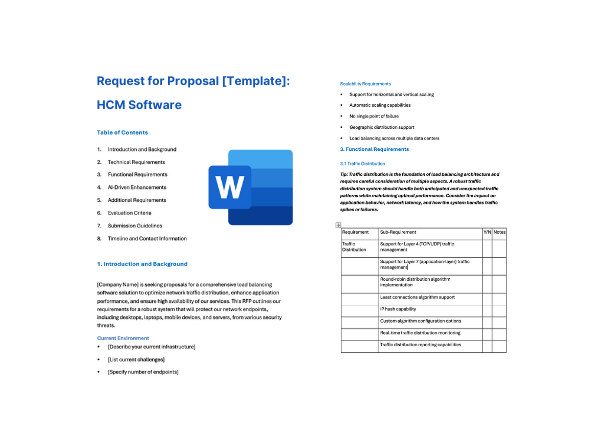
Request for Proposal: Human Capital Management (HCM) Software Solution
Table of Contents
- Introduction and Background
- Project Objectives
- Technical Requirements
- Functional Requirements
- AI-Powered Features
- Vendor Qualifications
- Evaluation Criteria
- Submission Guidelines
- Timeline
1. Introduction and Background
[Company Name] is seeking proposals for a comprehensive Human Capital Management (HCM) software solution to streamline our HR processes and enhance our workforce management capabilities. This RFP outlines our requirements for a scalable, user-friendly platform that will support our organization’s growth and evolving needs.
Current Environment
- Existing HR systems and processes requiring modernization
- Need for integrated workforce management solutions
- Focus on employee experience and self-service capabilities
- Requirements for advanced analytics and reporting
Project Goals
- Implement a unified HCM platform
- Enhance operational efficiency
- Improve employee experience
- Enable data-driven decision making
- Ensure compliance with regulatory requirements
2. Project Objectives
Primary Objectives
- Implement a centralized employee database with comprehensive personnel information management
- Streamline payroll processing with multi-jurisdiction support and tax compliance
- Enhance benefits administration through automated eligibility and enrollment processes
- Improve recruitment and applicant tracking capabilities
- Develop robust performance management and learning systems
- Enable advanced HR analytics and reporting capabilities
- Implement AI-powered features for improved efficiency and decision-making
Success Criteria
- Successful integration with existing systems
- Improved efficiency in HR processes
- Enhanced employee self-service capabilities
- Reduced manual workload for HR staff
- Improved data accuracy and reporting capabilities
- Positive user adoption rates
3. Technical Requirements
System Architecture Requirements
- Cloud-based SaaS solution
- Mobile accessibility (responsive design or dedicated app)
- Integration capabilities (API support, data import/export)
- Security and data protection features
- Scalability to support organizational growth
- Customization options for workflows and reporting
- Multi-language and multi-currency support
Security Requirements
- Data encryption at rest and in transit
- Role-based access control
- Multi-factor authentication
- Regular security audits and updates
- Compliance with industry security standards
- Backup and disaster recovery capabilities
Integration Requirements
- API-based integration capabilities
- Support for standard data formats
- Real-time synchronization capabilities
- Secure data transfer protocols
- Custom integration development support
- Pre-built connectors for common systems
Performance Requirements
- 9% system availability
- Response time under 2 seconds
- Support for concurrent users
- Scalable infrastructure
- Performance monitoring and reporting
- Load balancing capabilities
4. Functional Requirements
4.1 Core HR Management
Tip: This foundational module serves as the central repository for all employee data and organizational structures. A robust core HR system should provide single-source-of-truth functionality while maintaining data accuracy, compliance, and easy accessibility for authorized users across the organization.
| Requirement |
Sub-Requirement |
Y/N |
Notes |
| Centralized employee database |
– Single source of truth for employee records- Unique identifier management- Historical data tracking- Data validation rules |
|
|
| Personal information management |
– Contact details- Emergency contacts- Document storage- Custom fields capability |
|
|
| Job details tracking |
– Position history- Role definitions- Department assignments- Location tracking |
|
|
| Employment history |
– Previous positions- Promotions tracking- Transfer history- Status changes |
|
|
| Organizational structure |
– Hierarchical view- Reporting relationships- Department structures- Multiple business units |
|
|
4.2 Payroll Processing
Tip: An effective payroll module must handle complex calculations while ensuring compliance across multiple jurisdictions. The system should automate routine tasks while providing flexibility for unique scenarios and maintaining detailed audit trails.
| Requirement |
Sub-Requirement |
Y/N |
Notes |
| Automated calculations |
– Gross-to-net processing- Tax calculations- Benefit deductions- Overtime calculations |
|
|
| Multi-jurisdiction support |
– Multiple state/country support- Tax jurisdiction management- Local compliance rules- Currency handling |
|
|
| Tax compliance |
– Automated tax updates- Filing assistance- Tax form generation- Compliance reporting |
|
|
| Payment distribution |
– Direct deposit- Check printing- Multiple accounts- Payment scheduling |
|
|
| Payroll reporting |
– Standard reports- Custom report builder- Audit trails- Historical data access |
|
|
4.3 Benefits Administration
Tip: Effective benefits administration requires seamless integration of complex eligibility rules, carrier connections, and employee self-service capabilities while ensuring compliance with regulatory requirements and maintaining accurate cost tracking.
| Requirement |
Sub-Requirement |
Y/N |
Notes |
| Benefits package definition |
– Plan setup and configuration- Coverage options- Cost structure management- Plan year management |
|
|
| Employee enrollment management |
– Open enrollment processing- Life event changes- Eligibility tracking- Dependent management |
|
|
| Rules-based eligibility |
– Automated eligibility determination- Waiting period management- Coverage rules enforcement- Status change handling |
|
|
| Self-service portal |
– Plan comparison tools- Online enrollment- Document access- Cost calculators |
|
|
| Provider integration |
– Data exchange with carriers- Premium reconciliation- Coverage verification- Claims integration |
|
|
4.4 Recruiting and Applicant Tracking
Tip: A comprehensive recruiting system should streamline the entire hiring process from job posting to offer acceptance, while providing tools for collaboration, compliance tracking, and candidate relationship management.
| Requirement |
Sub-Requirement |
Y/N |
Notes |
| Job posting and sourcing |
– Multi-channel posting- Template management- Social media integration- Job board management |
|
|
| Application management |
– Custom application forms- Document collection- Status tracking- Communication tools |
|
|
| Interview scheduling |
– Calendar integration- Automated scheduling- Room/resource management- Reminder systems |
|
|
| Candidate evaluation |
– Assessment tools- Rating systems- Feedback collection- Comparison tools |
|
|
| Offer management |
– Template management- Approval workflows- Electronic signatures- Onboarding initiation |
|
|
4.5 Onboarding
Tip: An effective onboarding system streamlines the transition from candidate to employee, ensuring consistent processes while reducing administrative burden and creating a positive first impression for new hires.
| Requirement |
Sub-Requirement |
Y/N |
Notes |
| New hire task management |
– Task templates- Automated workflows- Progress tracking- Deadline monitoring |
|
|
| Document organization |
– Form automation- E-signature integration- Document storage- Compliance tracking |
|
|
| Pre-boarding communication |
– Welcome materials- Resource access- Schedule coordination- Team introductions |
|
|
| System integration |
– HR system sync- Payroll setup- Benefits enrollment- IT provisioning |
|
|
4.6 Performance Management
Tip: Performance management should facilitate continuous feedback and development while aligning individual goals with organizational objectives, supporting both traditional reviews and modern continuous assessment approaches.
| Requirement |
Sub-Requirement |
Y/N |
Notes |
| Goal setting and tracking |
– SMART goal templates- Progress monitoring- Alignment tools- Cascading objectives |
|
|
| Performance review processes |
– Review templates- Schedule management- Rating systems- Calibration tools |
|
|
| Feedback mechanisms |
– Real-time feedback- 360-degree reviews- Peer recognition- Development notes |
|
|
| Competency assessments |
– Skill matrices- Gap analysis- Development planning- Career pathing |
|
|
| Succession planning |
– Talent pools- Readiness assessment- Development tracking- Risk management |
|
|
4.7 Learning Management
Tip: A comprehensive learning management system should support diverse learning styles and delivery methods while tracking compliance, measuring effectiveness, and encouraging continuous development.
| Requirement |
Sub-Requirement |
Y/N |
Notes |
| Course content delivery |
– Multiple format support- Mobile accessibility- Learning paths- Resource library |
|
|
| Training progress tracking |
– Completion monitoring- Assessment tools- Certification tracking- Learning analytics |
|
|
| Compliance training |
– Mandatory course assignment- Due date tracking- Automated reminders- Completion reporting |
|
|
| Skills development |
– Skill gap analysis- Career path alignment- Development plans- Progress monitoring |
|
|
| Performance integration |
– Goal alignment- Development planning- Competency mapping- Success metrics |
|
|
4.8 Time and Attendance
Tip: Time and attendance management should provide accurate tracking while supporting flexible work arrangements and ensuring compliance with labor regulations and organizational policies.
| Requirement |
Sub-Requirement |
Y/N |
Notes |
| Time tracking |
– Multiple time entry methods- Schedule adherence- Exception handling- Mobile access |
|
|
| Leave management |
– PTO tracking- Leave request workflows- Balance calculations- Calendar integration |
|
|
| Scheduling capabilities |
– Shift planning- Coverage analysis- Schedule templates- Conflict management |
|
|
| Overtime monitoring |
– Threshold alerts- Approval workflows- Cost tracking- Compliance checks |
|
|
| Payroll integration |
– Time data export- Pay rule application- Exception reporting- Audit trails |
|
|
4.9 Compensation Management
Tip: Compensation management should support data-driven decisions while ensuring internal equity, external competitiveness, and alignment with organizational objectives and budgets.
| Requirement |
Sub-Requirement |
Y/N |
Notes |
| Salary structure |
– Pay grade framework- Range management- Market alignment- Budget planning |
|
|
| Merit increases |
– Performance linkage- Budget allocation- Approval workflows- Communication tools |
|
|
| Bonus tracking |
– Variable pay programs- Incentive calculations- Goal achievement linking- Payment processing |
|
|
| Total rewards |
– Statement generation- Benefits valuation- Compensation modeling- Communication tools |
|
|
| Pay equity analysis |
– Gap identification- Statistical analysis- Recommendation engine- Compliance reporting |
|
|
4.10 HR Compliance
Tip: Compliance management should provide proactive monitoring and reporting capabilities while ensuring adherence to changing regulations across multiple jurisdictions.
| Requirement |
Sub-Requirement |
Y/N |
Notes |
| Regulatory monitoring |
– Compliance updates- Rule interpretation- Impact assessment- Action planning |
|
|
| Policy management |
– Document control- Version tracking- Distribution tools- Acknowledgment tracking |
|
|
| Documentation tracking |
– Required records- Retention schedules- Audit support- Secure storage |
|
|
| Legal reporting |
– Standard reports- Custom reporting- Filing deadlines- Submission tracking |
|
|
| Compliance updates |
– Regulatory changes- Policy updates- Training requirements- Communication tools |
|
|
4.11 HR Analytics and Reporting
Tip: Analytics capabilities should provide actionable insights while supporting both operational reporting needs and strategic workforce planning through data visualization and predictive analytics.
| Requirement |
Sub-Requirement |
Y/N |
Notes |
| Customizable dashboards |
– Metric configuration- Real-time updates- Drill-down capability- Mobile access |
|
|
| Standard reporting |
– Pre-built templates- Scheduled distribution- Export options- Parameter selection |
|
|
| Ad-hoc reporting |
– Report builder- Data filtering- Custom calculations- Save/share options |
|
|
| Predictive analytics |
– Trend analysis- Forecasting models- Risk assessment- Action planning |
|
|
| Data visualization |
– Chart types- Interactive displays- Presentation tools- Sharing options |
|
|
4.12 Employee Self-Service
Tip: Self-service functionality should empower employees while reducing administrative burden through intuitive interfaces and automated workflows.
| Requirement |
Sub-Requirement |
Y/N |
Notes |
| Personal information |
– Profile updates- Document access- Password management- Preference settings |
|
|
| Benefits enrollment |
– Plan selection- Coverage changes- Dependent management- Cost modeling |
|
|
| Time-off requests |
– Leave balances- Request submission- Calendar view- Status tracking |
|
|
| Pay information |
– Pay stub access- Tax documents- Direct deposit- W-4 updates |
|
|
| Career development |
– Training access- Goal setting- Performance reviews- Development plans |
|
|
5. AI-Powered Features
5.1 AI-Assisted Recruitment
Tip: Modern recruitment requires intelligent automation to handle high volumes of candidates while ensuring fair evaluation and maintaining compliance with hiring regulations.
| Requirement |
Sub-Requirement |
Y/N |
Notes |
| Resume screening |
– Keyword matching- Skills analysis- Experience evaluation- Qualification verification |
|
|
| Candidate matching |
– Job requirement alignment- Cultural fit assessment- Skills gap analysis- Ranking algorithms |
|
|
| Chatbot interactions |
– Initial screening questions- FAQ handling- Interview scheduling- Status updates |
|
|
| Bias detection |
– Language analysis- Selection pattern monitoring- Diversity metrics- Recommendation auditing |
|
|
5.2 Employee Engagement Enhancement
Tip: AI-driven engagement tools should provide actionable insights while respecting employee privacy and supporting proactive intervention strategies.
| Requirement |
Sub-Requirement |
Y/N |
Notes |
| AI chatbots |
– Query handling- Policy clarification- Service requests- Automated responses |
|
|
| Sentiment analysis |
– Feedback analysis- Survey processing- Trend identification- Risk flagging |
|
|
| Predictive attrition |
– Risk factor analysis- Early warning indicators- Retention recommendations- Impact assessment |
|
|
| Experience recommendations |
– Personalized suggestions- Career development- Learning opportunities- Engagement activities |
|
|
5.3 Performance Management
Tip: AI-enhanced performance management should provide objective insights while supporting continuous feedback and development opportunities.
| Requirement |
Sub-Requirement |
Y/N |
Notes |
| Performance insights |
– Performance pattern analysis- Goal progress tracking- Productivity metrics- Benchmark comparisons |
|
|
| 360-degree reviews |
– Automated feedback collection- Response analysis- Theme identification- Rating normalization |
|
|
| Trend analysis |
– Historical performance tracking- Development patterns- Success indicators- Risk identification |
|
|
| Coaching recommendations |
– Skill gap analysis- Development suggestions- Resource recommendations- Action planning |
|
|
5.4 Learning and Development
Tip: AI-powered learning should deliver personalized experiences while optimizing skill development and ensuring alignment with both individual career goals and organizational needs.
| Requirement |
Sub-Requirement |
Y/N |
Notes |
| Learning recommendations |
– Skill-based matching- Content curation- Learning path creation- Resource optimization |
|
|
| Career pathing |
– Career trajectory analysis- Role matching- Development planning- Success modeling |
|
|
| Skill gap analysis |
– Current vs. required skills- Development priorities- Learning recommendations- Progress tracking |
|
|
| Adaptive learning |
– Content personalization- Pace optimization- Assessment adaptation- Progress monitoring |
|
|
5.5 Workforce Planning
Tip: AI-driven workforce planning should leverage predictive analytics to optimize staffing decisions while considering multiple scenarios and business objectives.
| Requirement |
Sub-Requirement |
Y/N |
Notes |
| Talent needs prediction |
– Demand forecasting- Skill requirements- Location planning- Cost modeling |
|
|
| Skills gap analysis |
– Current capability assessment- Future needs prediction- Development planning- Resource allocation |
|
|
| Scenario modeling |
– What-if analysis- Cost implications- Risk assessment- Impact evaluation |
|
|
| Succession suggestions |
– Leadership pipeline- Readiness assessment- Development needs- Risk mitigation |
|
|
5.6 AI-Powered HR Assistant
Tip: AI assistants should provide immediate, accurate responses while learning from interactions and maintaining consistency with organizational policies.
| Requirement |
Sub-Requirement |
Y/N |
Notes |
| Natural language processing |
– Query understanding- Context awareness- Multi-language support- Response accuracy |
|
|
| Task automation |
– Priority assessment- Workflow triggers- Status tracking- Escalation handling |
|
|
| Document processing |
– Content analysis- Classification- Data extraction- Filing automation |
|
|
| Policy interpretation |
– Rule application- Guidance provision- Exception handling- Update integration |
|
|
5.7 Dynamic Skills Management
Tip: AI-driven skills management should provide real-time insights while supporting agile talent deployment and development planning.
| Requirement |
Sub-Requirement |
Y/N |
Notes |
| Skills inventory |
– Skill identification- Proficiency assessment- Currency tracking- Gap analysis |
|
|
| Data analysis |
– Trend identification- Usage patterns- Development tracking- Impact assessment |
|
|
| Internal mobility |
– Role matching- Project staffing- Development opportunities- Success prediction |
|
|
| Market analysis |
– Skill demand tracking- Compensation analysis- Industry trends- Competition monitoring |
|
|
5.8 Generative AI Capabilities
Tip: Generative AI features should enhance content creation and communication while maintaining appropriate tone and organizational standards.
| Requirement |
Sub-Requirement |
Y/N |
Notes |
| Content summarization |
– Document analysis- Key point extraction- Format optimization- Audience adaptation |
|
|
| Documentation assistance |
– Template generation- Content suggestions- Style consistency- Quality checks |
|
|
| Report generation |
– Data analysis- Insight extraction- Narrative creation- Visual suggestions |
|
|
| Communication drafting |
– Message creation- Tone adjustment- Multi-channel support- Personalization |
|
|
5.9 Payroll Intelligence
Tip: AI-powered payroll features should enhance accuracy and efficiency while providing proactive insights and anomaly detection.
| Requirement |
Sub-Requirement |
Y/N |
Notes |
| Payslip explanations |
– Variance analysis- Change highlighting- Detail clarification- Query handling |
|
|
| Process management |
– Efficiency analysis- Error prevention- Workflow optimization- Compliance checking |
|
|
| Anomaly detection |
– Pattern recognition- Error identification- Risk flagging- Resolution suggestions |
|
|
| Payroll forecasting |
– Cost projection- Budget planning- Scenario modeling- Impact analysis |
|
|
6. Vendor Qualifications
Required Experience and Capabilities
- Minimum 5 years in HCM software development and implementation
- Proven track record with similar-sized organizations
- Demonstrated financial stability and growth
- Established customer base in relevant industries
- Comprehensive implementation methodology
- Robust training and support programs
Support Infrastructure
- 24/7 technical support availability
- Multiple support channels (phone, email, chat)
- Dedicated customer success team
- Regular system maintenance and updates
- Comprehensive documentation and knowledge base
- User community and feedback programs
Technical Expertise
- Certified technical team
- Security certifications and compliance
- Integration experience with major systems
- Mobile development capabilities
- Cloud infrastructure expertise
- Data migration experience
7. Evaluation Criteria
Proposals will be evaluated based on the following criteria:
Solution Capability (40%)
- Functional requirements fulfillment
- Technical requirements compliance
- AI capabilities implementation
- Integration capabilities
- User interface and experience
- Mobile functionality
Implementation and Support (25%)
- Implementation methodology
- Project team expertise
- Training approach
- Support services
- Change management
- Documentation quality
Vendor Profile (20%)
- Company stability
- Industry experience
- Customer references
- Innovation track record
- Partnership ecosystem
- Future roadmap
Cost Structure (15%)
- Total cost of ownership
- Pricing model
- Implementation costs
- Ongoing maintenance costs
- Training costs
- Additional service costs
8. Submission Guidelines
Proposal Format Requirements
- Executive Summary
- Company Background
- Solution Overview
- Technical Approach
- Implementation Methodology
- Support and Maintenance
- Training Approach
- Pricing Details
- Client References
Required Documentation
- Detailed solution specifications
- Implementation timeline and plan
- Sample project team structure
- Support service level agreements
- Standard contract terms
- Security and compliance documentation
- Financial statements
- Insurance certificates
Submission Instructions
- Submit proposals electronically to [EMAIL]
- Provide [NUMBER] hard copies to [ADDRESS]
- Submission deadline: [DATE/TIME]
- Questions due by: [DATE]
- Bidders’ conference: [DATE]
9. Timeline
RFP Process Schedule
- RFP Release Date: [DATE]
- Bidders’ Conference: [DATE]
- Questions Deadline: [DATE]
- Proposal Due Date: [DATE]
- Vendor Presentations: [DATE RANGE]
- Selection Decision: [DATE]
- Contract Negotiation: [DATE RANGE]
- Project Kickoff: [DATE]
Implementation Timeline Expectations
- Phase 1: Core HR & Payroll – [TIMEFRAME]
- Phase 2: Talent Management – [TIMEFRAME]
- Phase 3: Learning & Development – [TIMEFRAME]
- Phase 4: Advanced Features – [TIMEFRAME]
10. Contact Information
Primary Contact
- Name: [NAME]
- Title: [TITLE]
- Email: [EMAIL]
- Phone: [PHONE]
Technical Contact
- Name: [NAME]
- Title: [TITLE]
- Email: [EMAIL]
- Phone: [PHONE]